I began writing this yesterday at RVA JS.
Today I’m at RVA JS 2018, Richmond’s second annual JavaScript developer’s conference.
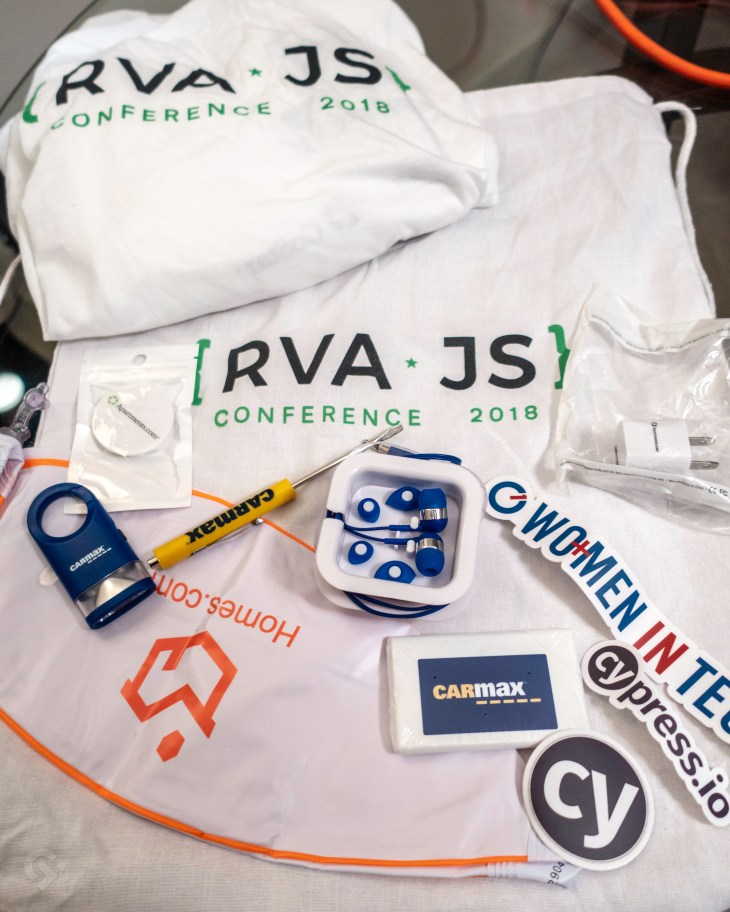
I haven’t been to a conference in ages. I’ve always wanted to attend conferences for UI/UX Design and Front End Web Development, come back to the workplace with useful knowledge, and have constructive impact. Somehow, for budgetary reasons usually, I routinely missed the travel/conference/education boat.
Out of a sense of nostalgia, I googled the possibilities and was excited to see that there are options within striking distance. Since I have plenty of time on my hands these days, in theory, I figured it would be a wise investment of time and energy to check out some of the Mid-Atlantic’s tech conferences.
Since I’ve been all over YouTube and the internet reading and scouring articles, trying to nail down some sense of direction and interest in this new dev world, it’s interesting to see the difference between local, national, and international thoughts and trends. Are there a few gurus unintentionally dictating our developer lives through proclamations? Is the web dev community skeptically but too willingly influenced by the cult of personality?
Never a dull moment, but always forward.
LET’S GET CONFERENCING
I’m not a strong networker (and I’m exhausted today), but it’s still fun to meet a few folks, find out why they’re here, and get a taste of Richmond’s tech world. Richmond is about an hour and a half+ south of Washington, DC by car.
I’m having a hard time picking which talks to go to.
So far, I’ve done:
E2E Testing with Cypress – Don Denoncourt
- I don’t have much experience with testing frameworks. It’s interesting to get a glimpse of the open source (to an extent) testing world.
- Wow. It just works. There are some priced options, too, apparently. That’s how they getcha.
- Making a mental note to compare to Jest.
Learn Redux by Writing Redux – Matt Crowder
- In theory, I just learned about all of this over the past month or so in Udacity’s course. I’m working on that project right now. Still, it was like drinking from a firehose. Maybe this is a downside of doing an online course. (A physical classroom would have been ideal.) You’re learning but you aren’t talking shop as you go. There’s power in digesting and putting thoughts into words. I find it hard to follow along when things get heady — lagging behind the conversation — but I’m not the only one.
- Very functional programming. Much curry.
Handling Angular 2+ Forms – Jennifer Wadella, @likeOMGitsFEDAY
- I haven’t seen any Angular code since my last few weeks at General Dynamics. I get the feeling that if I were still there, the team could use this info about Control Value Accessors (CVA).
- In short, Angular has capable form validation features and there’s no need to roll your own.
- She reminds me of Silicon Valley.
- Avril Lavigne-themed JS presentation. Thumbs up.
I’m still up in the air with the afternoon sessions. Let’s find out which I chose!
Intro to Web Components – Chris Lorenzo, @chiefcll
- What are web components? Who is Web Components? When are we? (Why am I so tired.)
- Custom elements vs. a library or framework?
- Web components are more of an under-the-hood thing for now. The frameworks that we use are most likely taking advantage of them. IE 11 and Edge are close to getting on board.
- There are some interesting restrictions/limitations. Slot elements: only first-level children get the css style??
- I’m thinking that in a few more revs, whatever frameworks are in play will be a thin wrapping over browser-available features. Some may be out of favor like my beloved jQuery.
The How’s and Why’s of Flexible React Components – Jenn Creighton, @gurlcode
- Beware the aPROPcalypse! Ha! Wow. A button with fourteen required props. There’s a lot of business logic in that component. That’s a no-no.
- Render props in full effect!
- It must have been immensely satisfying to take that heavy, tired component and whip it into a lean mean, reusable, and truly flexible component. It’s code is pretty just to look at now.
- Hmmm. In my current class project, I have an avatar image that I want to reuse, but I want it to display differently depending on the context: dimensions, shape, animation(?). This could help.
UX for Developers – John Athayde, @boboroshi
- “UX Debt is Technical Debt.” Truuuuuue.
- This is good info. It’s good to get back to my roots. I came up, career-wise, immersed in design and have always thought of myself as a voice of design reason throughout my career. A lot of times, developers literally don’t see (or don’t care about) things that drive me bananas. I’d like to get some kind of certification, if not a degree, though.
- I’d love to work in an environment where design is on par with development. Usually, in my experience, it’s all about the code and getting it out of the door and bug free. Developer’s priorities trump designer’s priorities. User experience is increasingly important but has, historically, always taken a back seat to coding deadlines and milestones, in my frustrated experience.
THE SOCIAL ASPECT
There’s a pretty good mix of people here, relatively speaking. It is largely male and, er, Caucasian, but that’s showbiz, baby. I do appreciate that there’s an effort to be inclusive and to make it clear that antisocial behavior, for lack of a better phrase, won’t be tolerated. I can’t imagine being a woman at some of these events, especially when the industry was/is much less woke.
If you don’t already agree with the statement I’m about to write, I can’t convince you of its worth, but here goes:
Representation is important.
There are some brilliant people out there in the world who will never realize their potential because they have very little idea of all of the possibilities.
I’m a black guy. I don’t how to quantify my experiences. I can tell you that I wouldn’t be where I am today if certain people hadn’t shown me doors that I didn’t know existed and given me a gentle push towards them. Thanks, Denise Coley, Mack, Joy Mountford, Gitta Salomon, Kurt Schmucker, and Dr. Hrabowski among others, and to my parents for seeing the possibilities.
Does it matter? I would emphatically say yes but that’s a conversation for another blog entry. Meanwhile, get in here and participate, y’know.
It’s partially about, how can we all contribute? It’s also about, what problems are we going to solve? What are our priorities? Can we have fun, can we innovate, can we help people, can we serve our communities (businesses are a part of their communities) and can we make money or some other ROI doing it? Sure, society may desperately be clamoring for a $500 subscription model gold-plated juice packet squeezer, but society may also be able to benefit from a more informed and engaged electorate, or, let’s say, a digital textbook tablet share.
Who’s deciding what matters and why/how? Would that change if the halls of the tech world were more diverse?
</end soapbox>
Anyway, I’m trash at networking unless I have a wing-person. I’m also wicked tired. I took a low quality nap in the car. I’m not sure if it helped. Unnecessarily taking notes is helping to keep me awake, though. Don’t get me wrong. The talks are interesting – fascinating, even. I’m just sleep deprived and got up early to drive down.
One thing is clear. There are more changes coming in the web world. Like the weather, like seismic shifting. There’s no end in sight and those changes are going to affect all browser technology, development, frameworks, and libraries. Whatever web tech we’re using and learning, it’s changing – right now – under our feet. It’s a lively evolving ecosystem.
Did you just write some clean code for your project? It’s pretty much out of date already. Good luck.
Whoo boy. Worth it, but it’s going to be a long day. Two more sessions to go.
Next stop: NationJS in December
 Dino-Coding