The code is here. When I figure out how to serve it, I will. UPDATE: GitHub Pages!
I just submitted project two, the “Would You Rather” app.
This link to the deployed app almost works: https://mcstrings.github.io/would-you-rather/
Note: The first page you’ll see is a 404 error. Just click on one of the links to get things started. GitHub Pages doesn’t play well with React’s router, apparently, and at the moment I’ve got thangs to do other than putz around with it.
Code is here: https://github.com/mcstrings/would-you-rather

Login using Adorable Avatars 
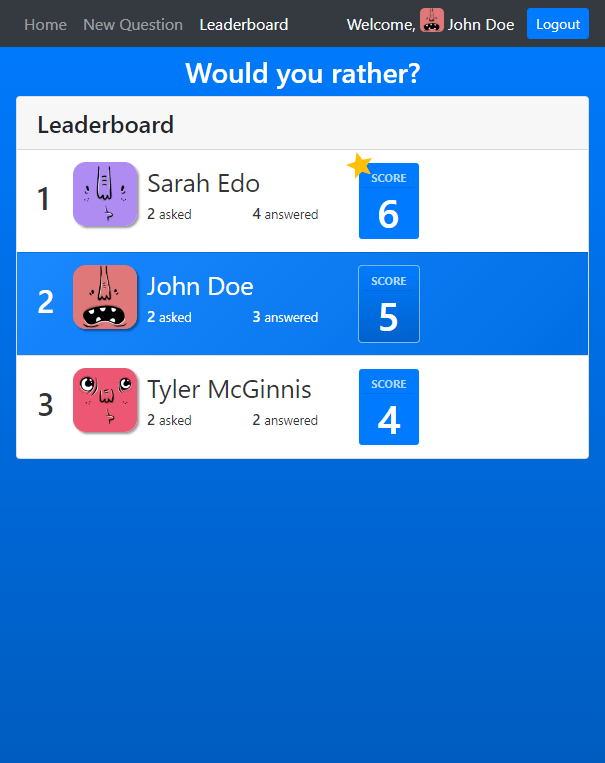
Leaderboard 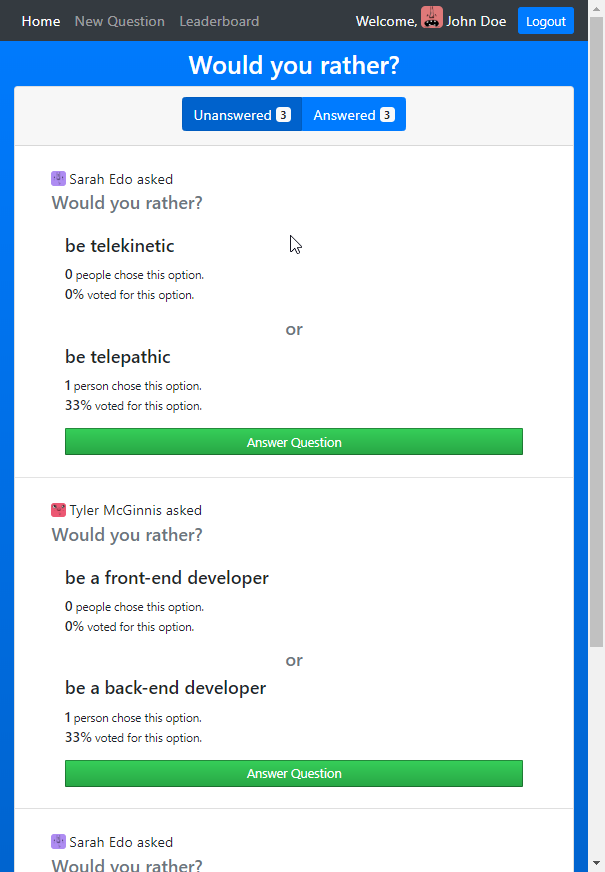
Responsive layout 
Using React Bootstrap 4
But first … Design
I’m not going to pretend that I planned this out well. Everybody has a plan until they get punched in the face.


Having a global “single source of truth” state is different. When async calls attack.
I decided to use Bootstrap 4, which lead to React-Bootstrap. I chose it because, at the time, I had an upcoming interview and I needed to reacquaint myself with Bootstrap and newly acquaint myself with Bootstrap 4. All of the UI frameworks each have their own flavor, the same way sandwich shops each have their own aroma when you walk in the door.
They’re definitely useful and can make laying out the UI responsively so much easier, even if it requires a lot of googling. Note: React-Bootstrap now supports Bootstrap 4, but I can save you some time by directing you to their migration page.
REDUX
Redux is powerful. No doubt. But it feels half baked. No, that’s not right. Because the functionality is there. It’s just missing a layer of useful abstraction. I’m not the only who thinks, so apparently.
There’s an ecosystem of Redux simplifiers, some of them elegant but not fully potent.
Why isn’t accessing global state as straightforward as getting a component’s state? There’s a lot of boilerplate to get right. But it’s undeniable that it’s clunky, verbose, repetitive, and bit of a chore. My progress screeched to a halt as soon as I incorporated Redux.
I love the way React apps just work once you have a component’s state sussed out and your components wired. Of course, I’ve only worked with projects and contrived examples. Real world apps are orders of magnitude deeper, broader, and under various demands and constraints.
I didn’t realize that the following article is about yet another library, but what you can you do, eh. I have NOT used this, and it’s not a replacement for Redux, but:
I wonder if they’ll talk about a new wave in state management at Nation JS tomorrow.
How’s the course going?
Udacity is pretty good but you’re going to have to supplement your learning as you go. Their discussion board and knowledge base are in their infancy, so they’re not as helpful as they could or should be. It’s frustrating at times.
If you have the time and money, always opt for an in-person course.
The mentors don’t participate in the “My Classmates” chat room, only in the project chat rooms so students are left to fend for themselves.
- A like option would actually be useful here. Many likes would provide some clues as to which comments provide useful info. A like indicator would also act as a landmark back to comments I’d like to read later.
- How can I see a comment from two months ago (without scrolling endlessly and possibly fruitlessly because I get the impression that old comments are deleted??).
- There’s no way to search comments so the same questions are popping up.
There’s a “Knowledge” section as well, meant to be “Udacity’s own ‘StackOverflow'”.
I get the feeling that Udacity is steadily beefing up its features. It won’t be ready for prime time before I finish the course, though. So it goes. Isn’t that always the way with universities?
Anyway, I should be coding instead of writing. On to the final section: React Native.
 Dino-Coding